
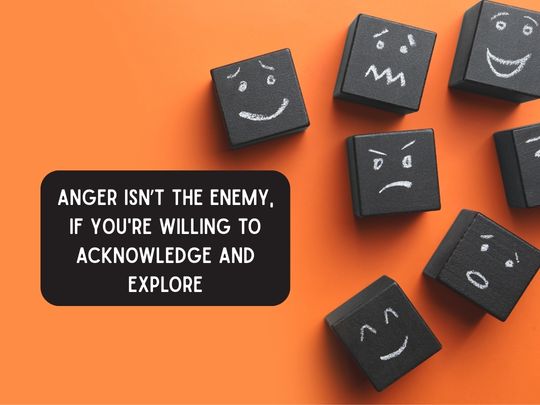
Whether it’s war, politics or economic pressures causing your emotions to overheat, or work-related stress, road rage or even your favourite sports team losing the league, there are many reasons to feel angry.
Research suggests the average adult experiences anger up to 14 times a week. And, young people are following in the footsteps of this trend, largely fuelled by the digital revolution, as constant notifications and social media comparisons impact how they experience frustration over time.
I recognise anger’s validity as a natural human emotion. Sitting neatly between ‘rage’ and ‘annoyance’ on the emotion wheel (and opposite the ‘fear’ group), it can have its benefits but only when it’s brought into the open to be handled in a calm and controlled manner.
Yet ‘anger management’ has deeply negative connotations because it assumes chaos. In reality, its starting point is one we can all learn from: the process of accepting anger, before understanding our triggers, patterns and impact on others. This self-awareness gives us better quality information about ourselves to determine the choices we then make.
Where does your anger come from?
How we express anger externally is partly influenced by our childhood, environment and culture. As we go through the ‘terrible twos’ (a normal developmental phase involving temper tantrums, made challenging by the lack of language to articulate our needs or manage emotions as we acquire new skills and confidence to grow in independence) parents typically buy our silence or ignores our cries altogether. But, neither path helps us to unpack why we were stirred up in the first place.
As an adolescent, society shaped me to believe that it was unladylike to be angry. And, as someone with dual heritage, I was conscious that the negative ‘angry Black woman’ trope could easily be used to dismiss women of colour who challenge the status quo. And, if that wasn’t enough, my Christian faith also made it easy to exclude anger from my emotional toolbox – in favour of prioritising empathy and practicing forgiveness.
Yet, anger cannot, and should not, be eliminated. But, if you haven’t seen it well modelled, it’s difficult to learn the ropes. For me the ‘loudest’ emotion after suppressing or minimising my anger was the self-loathing and guilt I’d experience. Even today, I’m particularly concerned with others’ perceptions of me, particularly co-workers, when we collaborate on difficult, complex and conflict-inducing projects.
Balancing my internal frustration and external response in real-time sometimes leads me to be uncharacteristically curt. Those who I trust, and can be vulnerable with, then do a wonderful job of trying to guide me through my assessment of the situation. But, really, I’m seeking redemption.
But are they objective?
Confidants aren’t guaranteed to be objective, which is why trained counsellors are the most effective people to talk to and review our relationship with anger with. They’re trained to understand the distinction between anger and underlying fear that’s emerged because of our boundaries or values being threatened.
For example, I might feel angry amidst overwhelming projects because the likelihood of communication faltering increases, which makes me feel excluded and less than. If I know and understand this, I can respond with healthier choices.
To explore our anger, we can start to ask ourselves:
- What happened, how did it make me feel and how was this expressed?
- What specifically made me angry?
- What did I need in this moment?
- How usual is this trigger and response?
- How does it affect my personal relationships?
To shout in an irrational manner at an undeserving colleague to make me temporarily feel good about myself, before entering a period of deep regret, is a misuse of power. (Thankfully this hasn’t happened to me personally, but I recognise I’m capable). But, channelling my energy into reviewing project processes to sustain good communication, even under pressure, benefits everyone.
Talking through your anger not only helps your mental health – reducing the risk of depression and anxiety – but also keeps any physical issues at bay such as sleep disorders or heart disease.
Counsellors can’t promise instant harmony, but better management will lead to a more fulfilling life, for you and the people around you.
If you’re based in South West London and would like to talk to a counsellor about anger, fear or other emotions you may be feeling, contact The Fountain Therapy Trust for more details about our long-term, affordable counselling offer.
Donna is an integrative counsellor running a small private practice, while supporting The Fountain Therapy Trust.