
It’s heart breaking to know that over one million 16 to 24-year-olds woke up with no job, training or education to go to this morning, according to the latest labour market statistics. Yet, for all the personal benefits a job can offer – a sense of purpose, confidence and communication skills – young people are quickly forming a strong impression that work might pay, but it doesn’t invest.
With rising living costs and accelerating digital technology creating uncertainty, financial anxiety (a persistent state of fear around your money situation) is rising – shaping young people’s attitudes towards the future.
With more than half of young people concerned about their ability to afford household bills, Gen Z are highly frustrated at the thought of being priced out of living independently, starting a family or re-training for new careers. In fact, they’re learning the hard way that work isn’t reliably returning what they’re having to put into it. At the end of a long month, despite best endeavours, they may still be left short.
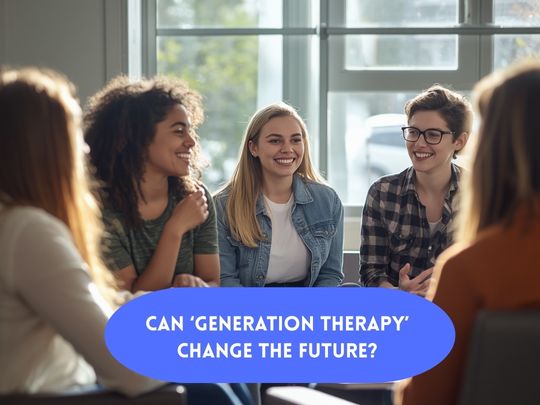
Yet, in all of this, I strongly admire Gen Z’s commitment to continue investing their hard-earned money into therapy. What keeps them coming back?
With an entire generation having endured back-to-back unprecedented events not of their making (a pandemic and lockdown, ongoing war and conflict, growing climate change and political instability), young people are conscious they’re paying the price for other people’s decisions and, therefore, require a non-judgemental outlet to help them process, navigate and reclaim life.
‘Keep Calm and Carry On’ just won’t cut it
More than this, as young people’s futures appear to sit firmly behind closed doors beyond their reach, it’s natural that their attention shifts from the future to the present – something they can shape and influence.
For those who can afford therapy, it’s prioritised as another step in their wellness routine –alongside gym memberships, healthy eating and fitness apps. Why? Because it’s a way to express agency while building self-awareness, resilience and connection. It’s also far more productive than ‘doom spending’ – a trend of purchasing non-essential items – from expensive coffees to cosmetics – to stave off anxious feelings.
What’s struck me in the counselling room is hearing clients repeatedly refer to ‘delayed milestones’. A term usually used to describe children’s physical, mental or social skills development, it’s associated with an individual missing the mark within their age group. Yet, in this context, I'm seeing young people express sadness around a perceived ‘failure to launch’ into adulthood like the generations that went before them. They saw a clear blueprint growing up, which has now become inaccessible, so they’re forced to remain on ‘survival mode’.
Although, some will accept the reality and focus on personal growth, others will commit to working hard to try to catch up on life goals, risking burnout, and a small proportion rebel against the system entirely (career and capitalism) to avoid further disappointment.
As an integrative counsellor, a professional who offers a flexible approach to therapy combining various theories to support individual clients, I’m glad my role isn’t to solve the issue. I couldn’t even if I wanted to. But I quietly admire their courage to open up and challenge the world we find ourselves in, while actively listening to their dreams and offering empathy as their confidence in attaining them fluctuates or fades.
No one knows what the future will look like, nor whether traditional life-stages (a career, a home, a family, a comfortable retirement) will continue to be revered. Without spiralling into a discussion as to which generation has it harder, let’s just agree that a lack of financial freedom, no matter the reason why, is universally painful. Which, in a week when the world’s first trillionaire was declared, is even more poignant.
But, if, in the long-term, it takes a dramatic wealth gap to encourage more young people to continue committing to improving their mental health, then perhaps one day we’ll look back on the 2020s as a cultural turning point where future generations to come are not only open to enhancing their emotional understanding, but demand it as part of their daily maintenance –
developing potential for a more honest, collaborative and progressive society. Some may even call it priceless.
The Fountain Therapy Trust, based in New Malden, offers long-term, affordable counselling to the local community, and regularly works with young adults to navigate anxiety, stress and depression. Visit our website and submit an enquiry form for more information to start your therapy journey.
Donna White MBACP is an integrative counsellor at The Fountain Therapy Trust and runs a small private practice.