
Following months of rumours and speculation, Brooklyn Beckham, eldest son of Sir David and Lady Victoria who uphold our nation’s sporting, music and fashion culture, recently took to social media to vent his family frustrations, concluding that he ‘does not want to reconcile’.
Brooklyn laments the lengths his family have gone to progress and preserve the Beckham brand, which must be a difficult pill for his parents to swallow having built part of their fortune through media deals with the likes of OK! Magazine, British Vogue and Netflix.
Yet strip away the accusations that have taken the internet by storm, and we’re left with a 26-year-old young man who’s likely exhausted with navigating the complex workings of a family empire while attempting to forge an independent identity.
Minus the millions, can you relate?
We can spend our younger years dreaming of being old enough to choose our own path and make our own decisions, while living under the protective rule of our family. Yet, when we take off, often to naturally turn back when the novelty wears off for a dose of TLC, it’s not a given they’ll be the same people we left behind. Just as our needs and priorities adjust, so do theirs.
It sounds obvious, but when we’re head down focused on our own personal growth – mine inspired by Mel Robbins’ hit book The Let Them Theory – it’s easy to forget.
To help deepen my family relationship, I recently reached out to my parents about why improving our communication was important to me. (There must be something in the water at the start of a new year when young adults, ahem, emerge with a desire to reboot their lives). However, I was mildly hurt when their first response failed to see any issues with our current dynamic, which immediately made me feel emotional at the idea I was expecting too much. After all, what 38-year-old wants more time with ‘mummy and daddy’?
The inner 8-year-old does.
At this age I was an only child. My brother’s introduction was a few years away and, for as much detail as I can reliably remember, it was an easy dynamic with routine and rhythm.
Yet this rhythm eventually became unpredictable and, in response to my family spreading their attention to accommodate my brother’s arrival, I responded by doubling down on a ‘good girl’ persona – becoming as self-reliant as possible.
So, three decades later, at a time when I want the opportunity to enjoy my family as an adult, by creating meaningful moments while we’re all in good health, why did I feel so vulnerable making the ask?
This isn’t just about being looked after, although there’s a deep comfort in letting a trusted and experienced adult literally take the wheel for a short time. It’s about spending intentional and present time with influential people who matter to me by understanding who we are now at this chapter of our lives. What’s concerning us? What’s bringing us joy? What can we do for one another?
Like all good relationships, you have to put the work in.
That’s not to say we’ve been absent from each other, but perhaps we’re somewhat guilty of taking our roles, needs and ways of relating for granted.
So, back to the awkward conversation. The arc leading up to it had been emotionally painful. I’d been feeling irritable, sad, frustrated and somewhat angry towards my parents for a short time without really understanding why. In hindsight I was feeling lonely and isolated. So, this attitude unhelpfully framed an unplanned and fumbled conversation fuelled by emotion. But, thanks to their patience, as we peeled away the layers, they began to see that the adult me was talking on behalf of my younger self.
Their empathetic response was necessary to help us switch from autopilot to manual, reminding us of the important and active roles we play in making our family collective comfortable – through continuous consideration of others alongside ourselves.
New rules, same players.
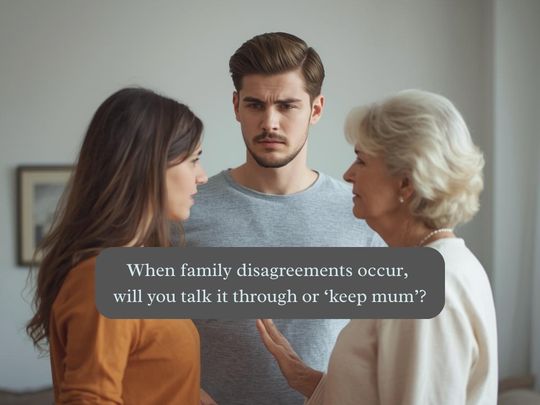
Whether you’re inviting your family to get closer or setting a respectful boundary, communication is key to achieving balance. Although your request may come from an innate desire to be served (like a child in need of nurturing), as healthy adults we must also be open to serving others (understanding alternative perspectives). Differences are natural, but distance isn’t necessarily the answer.
That’s why counselling can be a helpful, objective and non-judgemental outlet to explore family relationships before any form of emotional distancing is formally initiated. It can even be used to imagine or rehearse conversations you’d like to have with parents or siblings, or indeed your younger self, to build patience, understanding and empathy.
Brooklyn may have decided it’s too late. But my thought is that if a situation is repeatedly front of mind, generating overwhelming feelings, it’s far from over. Family estrangement is likely to have a negative impact on personal wellbeing, with the potential to lead to low self-esteem, aggression and depression – like a bereavement.
If any of this resonates with you, it’s important to unpack the path that led you to this place. Whether the destination is resolution, or radical acceptance of the current reality, the healthiest thing to do for your wellbeing is to make space to understand your feelings – and you don’t have to do this alone.
If you’re based in South West London and want to find out more about The Fountain Therapy Trust’s service, complete our contact form for more details.
Donna is an integrative counsellor running a small private practice, while supporting The Fountain Therapy Trust.